Rosemount, MN · Garage Door Service
Most Newport homes near Rosemount date to the 1970s, with original torsion hardware still common on doors - here's what we do and don't service in the area.
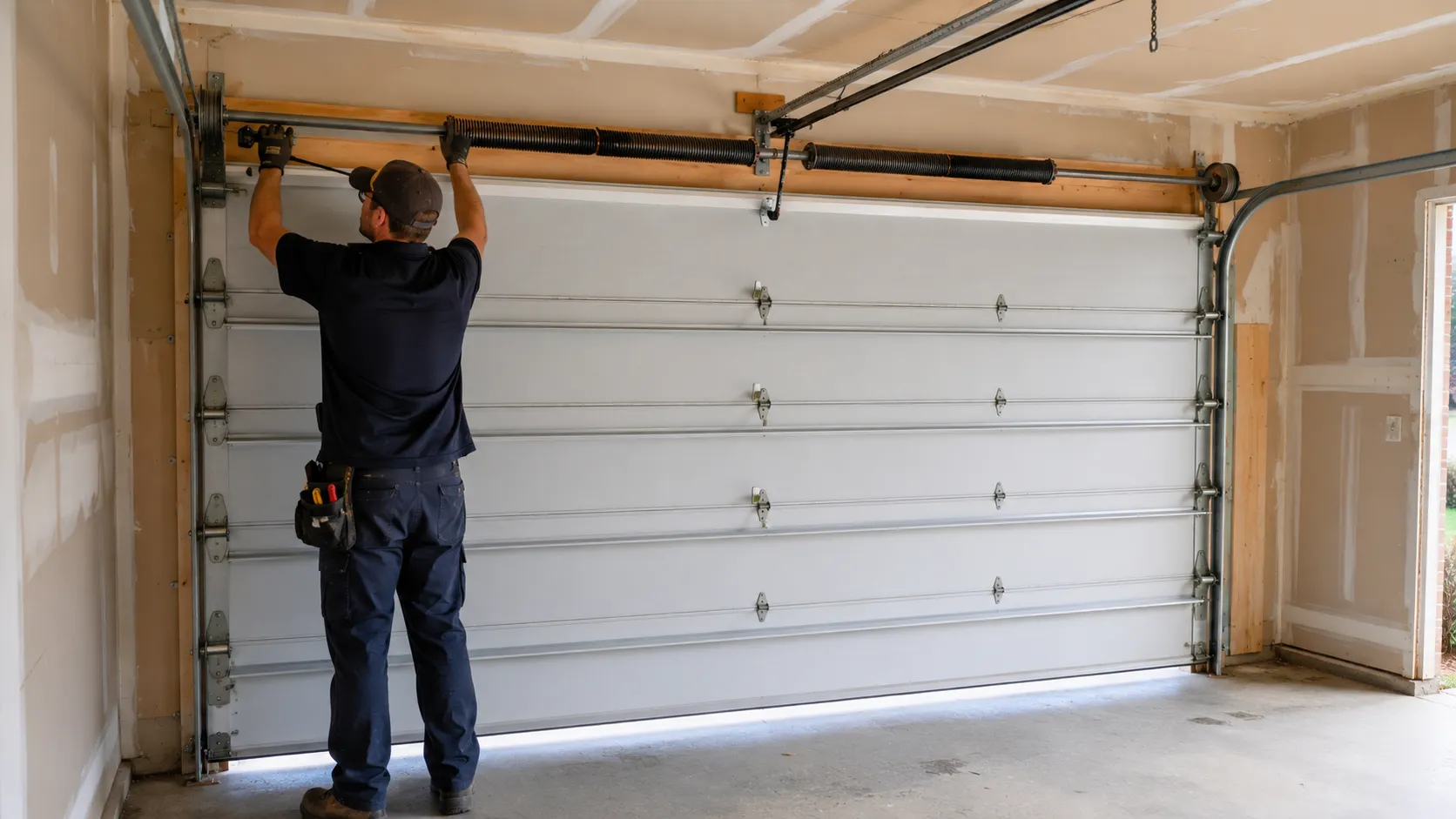
We work out of Rosemount, about 10 miles from Newport, so we don't run a depot or a stocked truck sitting in the neighborhood waiting for calls. If you need a door fixed the same hour, that's not a promise we're making here - we schedule the drive like any other job on the route. We also don't carry every obsolete part for a door built decades ago. Some of the original hardware on Newport's older doors was phased out by manufacturers years back, and if a part isn't available, replacement is the honest answer instead of a patch that fails again in a season. We don't push full door replacement when a spring, a cable, or a section of track will do the job - but we also won't tell you a forty-year-old steel door with rusted-through bottom panels is worth another repair just to make a sale. If the math doesn't work in your favor, we'll say so before we quote anything.
Newport's own housing sits right at the same midpoint as the wider Rosemount service area: a median build year of 1975, in a service territory where most of the stock across our 19 covered communities went up through the 1960s and 70s. That means the doors we see in Newport aren't a mixed bag of eras - they're mostly one generation of hardware, installed when steel sectional doors with torsion springs were becoming standard but before insulation, weather seals, and safety sensors were expected features. With 2,001 households in Newport, it's a small slice next to the 49,691 households across the full service area, and its median household income of $63,365 runs well under the area-wide $93,233. That income gap tends to show up as more deferred maintenance and more owners waiting until a spring actually snaps rather than replacing it on schedule.
On a 1975-era door, the failure we see most is a torsion spring that's simply worn out from cycle count, not from damage. These doors were built with single-spring torsion systems rated for lighter, uninsulated steel slabs, and after decades of daily openings the spring loses tension gradually before it finally lets go - usually on a cold morning when the steel has contracted and the opener has to work harder to break it loose. Rollers on original hardware are steel, not nylon, and by now most are worn oval instead of round, which shows up as a grinding or hopping motion partway up the track. Extension springs turn up on some of the older single-car doors instead of torsion, and those wear differently - fraying at the pulley rather than fatiguing at the shaft. We also see a fair number of openers original to the house, which are long past any realistic parts-availability window.
The area's cold-moderate climate band matters more on a door like this than it would on a newer one, because these 1970s steel doors have spent five decades expanding and contracting without any foam core to slow it down. That constant flex is part of why bottom panels rust from the inside out along the seam, and why a door that swung freely in August can feel stiff and heavy by January. A house built in 1975 in Newport almost certainly shipped with a single torsion spring rated for a lighter door than the double-car steel slabs sold today, so if a homeowner has swapped in a heavier replacement door over the years without upgrading the spring, the balance is off and the opener strains on every cycle. Track misalignment is common too - original brackets weren't always lag-bolted into framing that's held up under decades of settling, and a door that's a quarter-inch out of plumb wears rollers and cables faster than one that's true.
Most doors here date to the mid-1970s and were built without insulated foam cores. In the area's cold-moderate climate, the steel panels contract and the torsion spring loses some working tension in the cold, so the opener has to pull harder than it does in warmer months. If the door's also carrying worn rollers, that stiffness gets worse.
No. We're based in Rosemount, about 10 miles away, and we drive out for scheduled jobs. We don't advertise a same-day guarantee or a local depot in Newport because we don't have one - we'll give you an honest window when you call.
Often, yes - a torsion spring or roller replacement on a sound steel frame is usually cheaper than a full replacement. But if the bottom panel has rusted through or the track brackets have pulled loose from settled framing, repair stops making financial sense and we'll tell you that up front.
Torsion springs on doors from this era are rated for a set number of open-close cycles, and most just wear out gradually rather than failing from one bad event. After close to fifty years of daily use, a sudden snap on a cold morning is typical, not a sign anything else is wrong with the door.
Call now or request a free quote - same-day service on most repairs, upfront written pricing.