Rosemount, MN · Garage Door Service
Newer housing, higher household income, an 18-mile drive from Rosemount - Lake Elmo's emergency garage door calls run differently than the rest of the service area. Here's how.
Lake Elmo's median household income sits at $153,407, well above the $93,233 median across the rest of the area this shop covers. That number matters before a single tool comes off the truck, because it's the number that decides whether a broken door gets fixed or replaced. On a household budget like that, a $280 spring job on a five-year-old insulated steel door is an easy yes. The same job on a door that's already had two openers and a bent track isn't - and we'll tell you that on the phone, not after we've opened the panel.
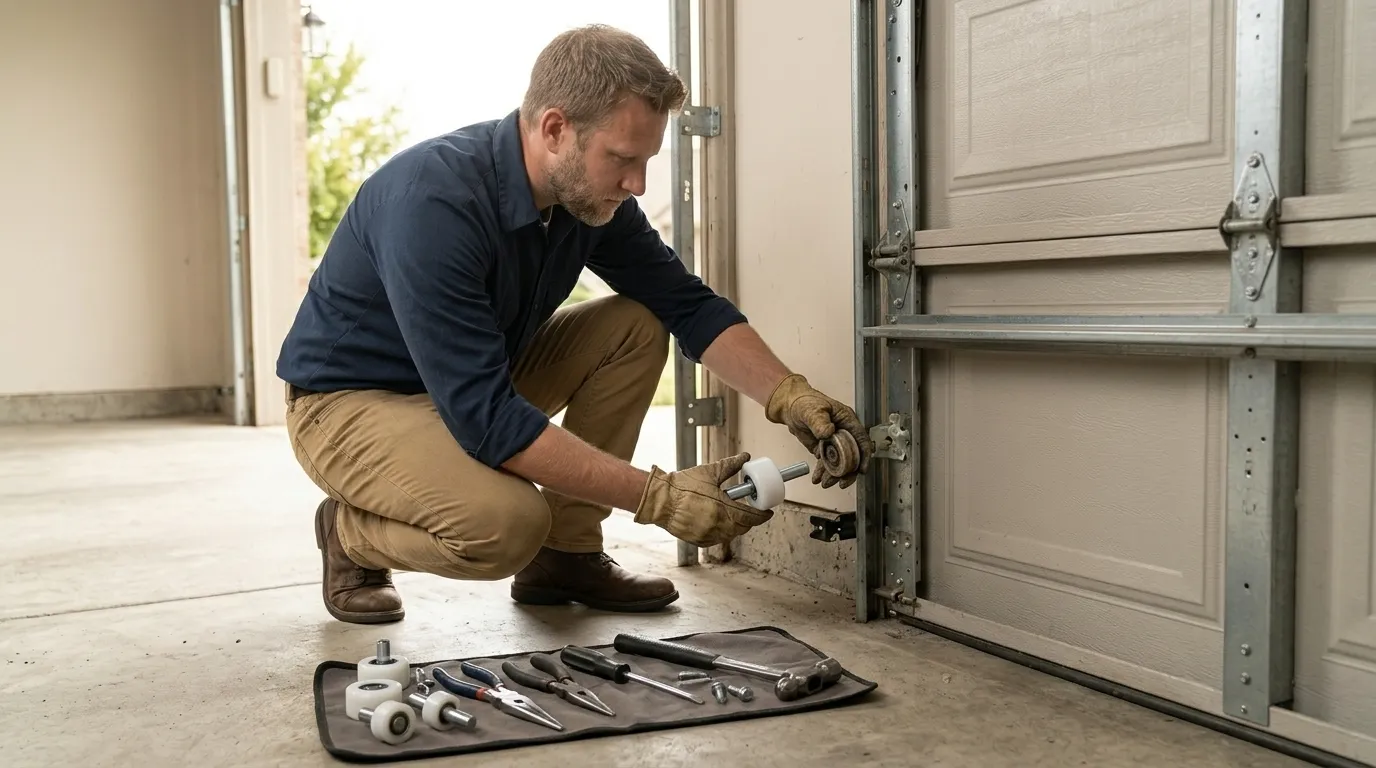
The truck itself carries torsion springs in the sizes that fit standard two-car residential doors, standard-drive openers and circuit boards, rollers, and cable. What it doesn't carry is anything sized for a one-piece door on side-mount hardware - because Lake Elmo mostly doesn't have that kind of door. We stock parts to match the housing, not parts to cover every era at once. If your door turns out to be older than the neighborhood typically runs, that's a call-ahead, not a truck-side improvisation.
We run this call from Rosemount, 18 miles out. That's not a quick hop across town, so when you call, we ask enough questions to load the right springs and opener parts before the truck leaves - torsion size, single or double door, opener brand if you know it. A stuck door with a broken spring and a stuck door with a dead opener board need two different parts kits, and we'd rather load both than come back a second time.
With around 4,575 households in Lake Elmo, this isn't the highest-volume stop on the map, which is exactly why we ask more up front. Fewer routine calls here means fewer guesses about what's behind your particular door. Tell us the age of the house if you know it, whether the door is original to the build, and what it's doing right now - won't open, won't close, opens partway and stops. That's the difference between one visit and two.
Most Lake Elmo garages went up around a median build year of 2002, which puts the housing stock a couple decades ahead of the 1960s-70s pockets that make up a lot of the wider service area. That gap shows up directly in what breaks. Instead of one-piece doors on worn-out side-mount torsion hardware, we're mostly looking at factory-built sectional steel doors, standard center-mount torsion springs, and circuit-board openers with safety sensors at the bottom of the track.
The common emergency call here isn't a snapped spring on ancient hardware - those doors haven't had time to wear that far yet. More often it's a sensor knocked out of alignment, an opener board that's failed outright, or a spring that's simply reached the end of its cycle count on a door that's been used daily for close to twenty years. Different fault, different fix, and usually a faster one.
A door built in the early 2000s is young enough that a fair number of homeowners here are tempted to troubleshoot it themselves before calling - and for some things, that's fine. Realigning a photo-eye sensor or replacing batteries in a remote isn't a safety issue. A torsion spring is. Those springs hold enough stored tension to break a hand or worse, and that doesn't change because the door is newer or the house is nicer.
Where we'd tell you to hold off entirely: if the door is stuck halfway and you can hear the opener straining, stop pulling the emergency release cord and stop running the opener. That's usually a broken cable or spring, not a motor problem, and forcing it risks the track bending - which turns a spring job into a track-and-panel job. One honest limit on our end: if a part is proprietary to a specific builder-grade opener and the manufacturer's discontinued it, we may need a day or two to source it rather than fix it on the spot.
The climate here is the same cold-moderate band as the rest of the region, so the freeze-thaw cycle that stiffens seals and thickens grease in winter hits Lake Elmo doors the same as anywhere nearby. What's different is the door itself. A 2002-era sectional door with a mid-grade opener wasn't built to the same tolerances as a premium door, and after roughly two decades of Minnesota winters, the springs and rollers on a lot of these doors are approaching the end of their rated cycles at close to the same time.
That's the pattern we watch for on this side of the service area: not a single bad batch of hardware, but a wave of same-era doors hitting spring failure and opener failure within a few years of each other, because they were installed within a few years of each other. It's less about any one house and more about a neighborhood built in a tight window now aging in that same tight window.
It's the 18-mile distance, not a lack of parts. We load the truck based on what you describe on the phone, so a clear description of the door and the problem gets you a faster, single visit instead of a truck coming back a second time.
Depends on the age and the fault. Given the median income here, a lot of Lake Elmo homeowners can absorb a full replacement without much strain, but if the door is a 2002-era sectional steel door with a single failed spring, repair almost always makes more sense than replacement.
It's urgent but not dangerous the way a broken spring is. A misaligned photo-eye sensor is a quick fix once we're on site. Don't force the door closed manually while it's blinking - that usually means the safety system is doing its job.
Rarely need to - most of the housing here dates to around 2002, well past the one-piece door era. If your house is an older outlier, tell us when you call so we can check stock before the truck leaves Rosemount.
Call now or request a free quote - same-day service on most repairs, upfront written pricing.